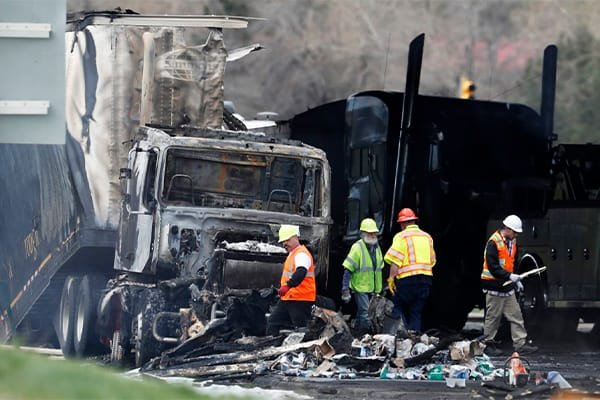
Why truck cases are different
A collision with a semi or commercial truck is a different kind of case than a car wreck. The injuries are usually more serious, there are more insurance layers, and more parties may share responsibility: the driver, the carrier, the trailer owner, the shipper who loaded it, even a maintenance contractor.
Commercial carriers often have a rapid-response team working the scene within hours. You need someone moving just as quickly on your side.
The evidence disappears on a schedule
Modern trucks record how they were driven: electronic logging devices, engine control data, dash cameras, GPS pings. Carriers also hold driver-qualification files, inspection records, and hours-of-service logs. Some of this can be legally destroyed in the ordinary course of business unless someone demands it be preserved.
One of the first things Paul M. Marriett does on a truck case is send a spoliation letter — a formal demand that the carrier preserve the vehicle, the data, and the records. Done early, it locks in the facts. Done late, the facts may be gone.
Common truck accident injuries
A loaded semi can weigh 20 to 30 times what a passenger car does, and that mismatch shows up in the injuries. On I-39/90/94, the Beltline, and the rural highways around Dane County, truck crashes tend to leave the people in the smaller vehicle with the most serious harm:
- Traumatic brain injuries — from the violence of the impact, with effects that can last months or permanently.
- Spinal cord injuries and paralysis — among the most life-altering outcomes, often requiring lifelong care.
- Multiple fractures and crush injuries — common when a truck overrides or rolls onto a smaller vehicle.
- Internal injuries — organ damage and internal bleeding that may not be obvious at the scene.
- Amputations, severe burns, and permanent scarring — from the crash forces, fires, or entrapment.
Because these injuries are often catastrophic, the future cost of care — not just the bills already in hand — is central to valuing the claim fairly.
Who can be held responsible
In a routine car crash there are usually two drivers. A truck case can involve several businesses, each with its own insurance and its own lawyers:
- The driver — for speeding, distraction, fatigue, or impairment.
- The trucking company — for pushing unrealistic schedules, hiring or keeping an unsafe driver, or failing to maintain its fleet.
- The trailer or truck owner — when the equipment itself was defective or poorly maintained.
- The company that loaded the cargo — when an unbalanced or unsecured load caused or worsened the crash.
- A parts maker or maintenance contractor — when brakes, tires, or other components failed.
Identifying every responsible party matters, because it often determines how much insurance coverage is actually available to make an injured person whole.
Federal rules that shape a truck case
Commercial trucks are governed by federal safety regulations that ordinary drivers never deal with. Violations of these rules can become powerful evidence:
- Hours-of-service limits — caps on how long a driver may be on the road before resting, tracked by electronic logging devices.
- Driver-qualification and testing rules — licensing, medical certification, and drug-and-alcohol testing requirements.
- Inspection and maintenance standards — required checks and repair records for the vehicle.
Wisconsin deadlines still apply. Most injury claims carry a three-year filing deadline, and Wisconsin's comparative-negligence rule lets you recover as long as you were not more at fault than the other side, reduced by your share of fault. But the federal evidence often disappears long before three years — another reason to act early.
What your claim can cover
Because truck crashes so often cause lasting injury, a well-built claim looks well beyond the immediate bills. Depending on the facts, compensation may include:
- Emergency and hospital care, surgery, and ongoing treatment;
- Long-term rehabilitation, in-home care, and future medical needs;
- Lost income and any lasting reduction in the ability to earn a living;
- Pain, suffering, and the effect of the injury on daily life;
- In a fatal crash, the losses a wrongful-death claim allows the family to recover.
No honest lawyer promises a number before reviewing the facts. What Paul M. Marriett does is make sure the claim reflects the full, long-term cost of a serious injury — not the figure an adjuster hopes you will accept early.
What a case costs
Cases like this are handled on a contingency-fee basis: no hourly bills, and the attorney fee comes out of any recovery. Clients may be responsible for litigation costs and expenses regardless of outcome — Paul M. Marriett explains exactly how that works, in writing, before you sign anything.
Frequently asked questions
How is a truck accident claim different from a car accident claim?
Truck cases usually involve more serious injuries, several potentially responsible companies, layers of insurance, and federal safety regulations. Critical evidence — like electronic logs and driver records — can also be lost quickly unless it is formally preserved.
Who can be held responsible for a truck crash?
Depending on the facts, responsibility may be shared among the driver, the trucking company, the trailer or truck owner, the company that loaded the cargo, and a parts maker or maintenance contractor. Identifying every party affects how much coverage is available.
Why do I need to act quickly after a truck accident?
Commercial carriers often have investigators working within hours, and truck data and records can be legally destroyed in the ordinary course of business. Acting early lets the attorney send a preservation demand before that evidence is gone.
What if the trucking company is based in another state?
Out-of-state carriers regularly operate on Wisconsin highways and can be pursued for crashes that happen here. Federal regulations apply nationwide, and the case can generally proceed in Wisconsin.
How long do I have to file a truck accident claim in Wisconsin?
Most Wisconsin injury claims carry a three-year filing deadline. But because key truck evidence can disappear far sooner, it is best to talk with an attorney as soon as possible after the crash.
How much does it cost to hire Paul for a truck accident case?
Truck cases are handled on a contingency-fee basis: no hourly bills, and the attorney fee comes out of any recovery. Clients may be responsible for litigation costs regardless of outcome, and Paul explains exactly how that works, in writing, before you sign.